History of detection
For centuries scientists, philosophers, and science fiction writers suspected that extrasolar planets existed, but there was no way of knowing whether they existed, how common they were, or how similar they might be to the planets of the Solar System. Various detection claims made in the nineteenth century were rejected by astronomers.
The first evidence of a possible exoplanet, orbiting Van Maanen 2, was noted in 1917, but was not recognized as such. The astronomer Walter Sydney Adams, who later became director of the Mount Wilson Observatory, produced a spectrum of the star using Mount Wilson's 60-inch telescope. He interpreted the spectrum to be of an F-type main-sequence star, but it is now thought that such a spectrum could be caused by the residue of a nearby exoplanet that had been pulverized into dust by the gravity of the star, the resulting dust then falling onto the star.
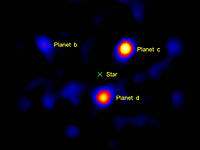
The first suspected scientific detection of an exoplanet occurred in 1988. Shortly afterwards, the first confirmation of detection came in 1992, with the discovery of several terrestrial-mass planets orbiting the pulsar PSR B1257+12. The first confirmation of an exoplanet orbiting a main-sequence star was made in 1995, when a giant planet was found in a four-day orbit around the nearby star 51 Pegasi. Some exoplanets have been imaged directly by telescopes, but the vast majority have been detected through indirect methods, such as the transit method and the radial-velocity method. In February 2018, researchers using the Chandra X-ray Observatory, combined with a planet detection technique called microlensing, found evidence of planets in a distant galaxy, stating "Some of these exoplanets are as (relatively) small as the moon, while others are as massive as Jupiter. Unlike Earth, most of the exoplanets are not tightly bound to stars, so they're actually wandering through space or loosely orbiting between stars. We can estimate that the number of planets in this faraway galaxy is more than a trillion.
Early speculationsedit
This space we declare to be infinite... In it are an infinity of worlds of the same kind as our own.
— Giordano Bruno (1584)
In the sixteenth century, the Italian philosopher Giordano Bruno, an early supporter of the Copernican theory that Earth and other planets orbit the Sun (heliocentrism), put forward the view that the fixed stars are similar to the Sun and are likewise accompanied by planets.
In the eighteenth century, the same possibility was mentioned by Isaac Newton in the "General Scholium" that concludes his Principia. Making a comparison to the Sun's planets, he wrote "And if the fixed stars are the centres of similar systems, they will all be constructed according to a similar design and subject to the dominion of One."
In 1952, more than 40 years before the first hot Jupiter was discovered, Otto Struve wrote that there is no compelling reason why planets could not be much closer to their parent star than is the case in the Solar System, and proposed that Doppler spectroscopy and the transit method could detect super-Jupiters in short orbits.
Discredited claimsedit
Claims of exoplanet detections have been made since the nineteenth century. Some of the earliest involve the binary star 70 Ophiuchi. In 1855 William Stephen Jacob at the East India Company's Madras Observatory reported that orbital anomalies made it "highly probable" that there was a "planetary body" in this system. In the 1890s, Thomas J. J. See of the University of Chicago and the United States Naval Observatory stated that the orbital anomalies proved the existence of a dark body in the 70 Ophiuchi system with a 36-year period around one of the stars. However, Forest Ray Moulton published a paper proving that a three-body system with those orbital parameters would be highly unstable. During the 1950s and 1960s, Peter van de Kamp of Swarthmore College made another prominent series of detection claims, this time for planets orbiting Barnard's Star. Astronomers now generally regard all the early reports of detection as erroneous.
In 1991 Andrew Lyne, M. Bailes and S. L. Shemar claimed to have discovered a pulsar planet in orbit around PSR 1829-10, using pulsar timing variations. The claim briefly received intense attention, but Lyne and his team soon retracted it.
Confirmed discoveriesedit
As of 1 November 2020, a total of 4,370 confirmed exoplanets are listed in the Extrasolar Planets Encyclopedia, including a few that were confirmations of controversial claims from the late 1980s. The first published discovery to receive subsequent confirmation was made in 1988 by the Canadian astronomers Bruce Campbell, G. A. H. Walker, and Stephenson Yang of the University of Victoria and the University of British Columbia. Although they were cautious about claiming a planetary detection, their radial-velocity observations suggested that a planet orbits the star Gamma Cephei. Partly because the observations were at the very limits of instrumental capabilities at the time, astronomers remained skeptical for several years about this and other similar observations. It was thought some of the apparent planets might instead have been brown dwarfs, objects intermediate in mass between planets and stars. In 1990, additional observations were published that supported the existence of the planet orbiting Gamma Cephei, but subsequent work in 1992 again raised serious doubts. Finally, in 2003, improved techniques allowed the planet's existence to be confirmed.
On 9 January 1992, radio astronomers Aleksander Wolszczan and Dale Frail announced the discovery of two planets orbiting the pulsar PSR 1257+12. This discovery was confirmed, and is generally considered to be the first definitive detection of exoplanets. Follow-up observations solidified these results, and confirmation of a third planet in 1994 revived the topic in the popular press. These pulsar planets are thought to have formed from the unusual remnants of the supernova that produced the pulsar, in a second round of planet formation, or else to be the remaining rocky cores of gas giants that somehow survived the supernova and then decayed into their current orbits.
On 6 October 1995, Michel Mayor and Didier Queloz of the University of Geneva announced the first definitive detection of an exoplanet orbiting a main-sequence star, nearby G-type star 51 Pegasi. This discovery, made at the Observatoire de Haute-Provence, ushered in the modern era of exoplanetary discovery, and was recognized by a share of the 2019 Nobel Prize in Physics. Technological advances, most notably in high-resolution spectroscopy, led to the rapid detection of many new exoplanets: astronomers could detect exoplanets indirectly by measuring their gravitational influence on the motion of their host stars. More extrasolar planets were later detected by observing the variation in a star's apparent luminosity as an orbiting planet transited in front of it.
Initially, most known exoplanets were massive planets that orbited very close to their parent stars. Astronomers were surprised by these "hot Jupiters", because theories of planetary formation had indicated that giant planets should only form at large distances from stars. But eventually more planets of other sorts were found, and it is now clear that hot Jupiters make up the minority of exoplanets. In 1999, Upsilon Andromedae became the first main-sequence star known to have multiple planets. Kepler-16 contains the first discovered planet that orbits around a binary main-sequence star system.
On 26 February 2014, NASA announced the discovery of 715 newly verified exoplanets around 305 stars by the Kepler Space Telescope. These exoplanets were checked using a statistical technique called "verification by multiplicity". Before these results, most confirmed planets were gas giants comparable in size to Jupiter or larger because they are more easily detected, but the Kepler planets are mostly between the size of Neptune and the size of Earth.
On 23 July 2015, NASA announced Kepler-452b, a near-Earth-size planet orbiting the habitable zone of a G2-type star.
On 6 September 2018, NASA discovered an exoplanet about 145 light years away from Earth in the constellation Virgo. This exoplanet, Wolf 503b, is twice the size of Earth and was discovered orbiting a type of star known as an "Orange Dwarf". Wolf 503b completes one orbit in as few as six days because it is very close to the star. Wolf 503b is the only exoplanet that large that can be found near the so-called Fulton gap. The Fulton gap, first noticed in 2017, is the observation that it is unusual to find planets within a certain mass range. Under the Fulton gap studies, this opens up a new field for astronomers, who are still studying whether planets found in the Fulton gap are gaseous or rocky.
In January 2020, scientists announced the discovery of TOI 700 d, the first Earth-sized planet in the habitable zone detected by TESS.
Candidate discoveriesedit
As of January 2020, NASA's Kepler and TESS missions had identified 4374 planetary candidates yet to be confirmed, several of them being nearly Earth-sized and located in the habitable zone, some around Sun-like stars.
In September 2020, astronomers reported evidence, for the first time, of an extragalactic planet, M51-ULS-1b, detected by eclipsing a bright X-ray source (XRS), in the Whirlpool Galaxy (M51a).
Also in September 2020, astronomers using microlensing techniques reported the detection, for the first time, of an earth-mass rogue planet unbounded by any star, and free floating in the Milky Way galaxy.


Comments
Post a Comment