General features
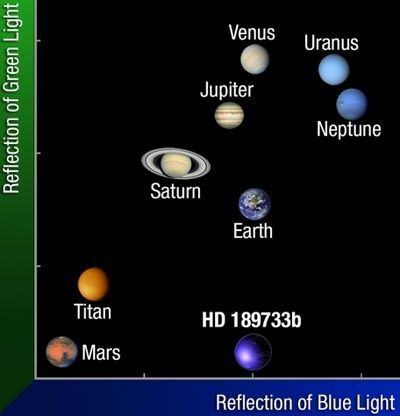
Color and brightnessedit
In 2013 the color of an exoplanet was determined for the first time. The best-fit albedo measurements of HD 189733b suggest that it is deep dark blue. Later that same year, the colors of several other exoplanets were determined, including GJ 504 b which visually has a magenta color, and Kappa Andromedae b, which if seen up close would appear reddish in color. Helium planets are expected to be white or grey in appearance.
The apparent brightness (apparent magnitude) of a planet depends on how far away the observer is, how reflective the planet is (albedo), and how much light the planet receives from its star, which depends on how far the planet is from the star and how bright the star is. So, a planet with a low albedo that is close to its star can appear brighter than a planet with high albedo that is far from the star.
The darkest known planet in terms of geometric albedo is TrES-2b, a hot Jupiter that reflects less than 1% of the light from its star, making it less reflective than coal or black acrylic paint. Hot Jupiters are expected to be quite dark due to sodium and potassium in their atmospheres but it is not known why TrES-2b is so dark—it could be due to an unknown chemical compound.
For gas giants, geometric albedo generally decreases with increasing metallicity or atmospheric temperature unless there are clouds to modify this effect. Increased cloud-column depth increases the albedo at optical wavelengths, but decreases it at some infrared wavelengths. Optical albedo increases with age, because older planets have higher cloud-column depths. Optical albedo decreases with increasing mass, because higher-mass giant planets have higher surface gravities, which produces lower cloud-column depths. Also, elliptical orbits can cause major fluctuations in atmospheric composition, which can have a significant effect.
There is more thermal emission than reflection at some near-infrared wavelengths for massive and/or young gas giants. So, although optical brightness is fully phase-dependent, this is not always the case in the near infrared.
Temperatures of gas giants reduce over time and with distance from their star. Lowering the temperature increases optical albedo even without clouds. At a sufficiently low temperature, water clouds form, which further increase optical albedo. At even lower temperatures ammonia clouds form, resulting in the highest albedos at most optical and near-infrared wavelengths.
Magnetic fieldedit
In 2014, a magnetic field around HD 209458 b was inferred from the way hydrogen was evaporating from the planet. It is the first (indirect) detection of a magnetic field on an exoplanet. The magnetic field is estimated to be about one tenth as strong as Jupiter's.
Exoplanets magnetic fields may be detectable by their auroral radio emissions with sensitive enough radio telescopes such as LOFAR. The radio emissions could enable determination of the rotation rate of the interior of an exoplanet, and may yield a more accurate way to measure exoplanet rotation than by examining the motion of clouds.
Earth's magnetic field results from its flowing liquid metallic core, but in massive super-Earths with high pressure, different compounds may form which do not match those created under terrestrial conditions. Compounds may form with greater viscosities and high melting temperatures which could prevent the interiors from separating into different layers and so result in undifferentiated coreless mantles. Forms of magnesium oxide such as MgSi3O12 could be a liquid metal at the pressures and temperatures found in super-Earths and could generate a magnetic field in the mantles of super-Earths.
Hot Jupiters have been observed to have a larger radius than expected. This could be caused by the interaction between the stellar wind and the planet's magnetosphere creating an electric current through the planet that heats it up causing it to expand. The more magnetically active a star is the greater the stellar wind and the larger the electric current leading to more heating and expansion of the planet. This theory matches the observation that stellar activity is correlated with inflated planetary radii.
In August 2018, scientists announced the transformation of gaseous deuterium into a liquid metallic form. This may help researchers better understand giant gas planets, such as Jupiter, Saturn and related exoplanets, since such planets are thought to contain a lot of liquid metallic hydrogen, which may be responsible for their observed powerful magnetic fields.
Although scientists previously announced that the magnetic fields of close-in exoplanets may cause increased stellar flares and starspots on their host stars, in 2019 this claim was demonstrated to be false in the HD 189733 system. The failure to detect "star-planet interactions" in the well-studied HD 189733 system calls other related claims of the effect into question.
In 2019 the strength of the surface magnetic fields of 4 hot Jupiters were estimated and ranged between 20 and 120 gauss compared to Jupiter's surface magnetic field of 4.3 gauss.
Plate tectonicsedit
In 2007, two independent teams of researchers came to opposing conclusions about the likelihood of plate tectonics on larger super-Earths with one team saying that plate tectonics would be episodic or stagnant and the other team saying that plate tectonics is very likely on super-Earths even if the planet is dry.
If super-Earths have more than 80 times as much water as Earth then they become ocean planets with all land completely submerged. However, if there is less water than this limit, then the deep water cycle will move enough water between the oceans and mantle to allow continents to exist.
Volcanismedit
Large surface temperature variations on 55 Cancri e have been attributed to possible volcanic activity releasing large clouds of dust which blanket the planet and block thermal emissions.
Ringsedit
The star 1SWASP J140747.93-394542.6 is orbited by an object that is circled by a ring system much larger than Saturn's rings. However, the mass of the object is not known; it could be a brown dwarf or low-mass star instead of a planet.
The brightness of optical images of Fomalhaut b could be due to starlight reflecting off a circumplanetary ring system with a radius between 20 and 40 times that of Jupiter's radius, about the size of the orbits of the Galilean moons.
The rings of the Solar System's gas giants are aligned with their planet's equator. However, for exoplanets that orbit close to their star, tidal forces from the star would lead to the outermost rings of a planet being aligned with the planet's orbital plane around the star. A planet's innermost rings would still be aligned with the planet's equator so that if the planet has a tilted rotational axis, then the different alignments between the inner and outer rings would create a warped ring system.
Moonsedit
In December 2013 a candidate exomoon of a rogue planet was announced. On 3 October 2018, evidence suggesting a large exomoon orbiting Kepler-1625b was reported.
Atmospheresedit
Atmospheres have been detected around several exoplanets. The first to be observed was HD 209458 b in 2001.
In May 2017, glints of light from Earth, seen as twinkling from an orbiting satellite a million miles away, were found to be reflected light from ice crystals in the atmosphere. The technology used to determine this may be useful in studying the atmospheres of distant worlds, including those of exoplanets.
Comet-like tailsedit
KIC 12557548 b is a small rocky planet, very close to its star, that is evaporating and leaving a trailing tail of cloud and dust like a comet. The dust could be ash erupting from volcanos and escaping due to the small planet's low surface-gravity, or it could be from metals that are vaporized by the high temperatures of being so close to the star with the metal vapor then condensing into dust.
In June 2015, scientists reported that the atmosphere of GJ 436 b was evaporating, resulting in a giant cloud around the planet and, due to radiation from the host star, a long trailing tail 14 million km (9 million mi) long.
Insolation patternedit
Tidally locked planets in a 1:1 spin-orbit resonance would have their star always shining directly overhead on one spot which would be hot with the opposite hemisphere receiving no light and being freezing cold. Such a planet could resemble an eyeball with the hotspot being the pupil. Planets with an eccentric orbit could be locked in other resonances. 3:2 and 5:2 resonances would result in a double-eyeball pattern with hotspots in both eastern and western hemispheres. Planets with both an eccentric orbit and a tilted axis of rotation would have more complicated insolation patterns.
Habitabilityedit
As more planets are discovered, the field of exoplanetology continues to grow into a deeper study of extrasolar worlds, and will ultimately tackle the prospect of life on planets beyond the Solar System. At cosmic distances, life can only be detected if it is developed at a planetary scale and strongly modified the planetary environment, in such a way that the modifications cannot be explained by classical physico-chemical processes (out of equilibrium processes). For example, molecular oxygen (O
2) in the atmosphere of Earth is a result of photosynthesis by living plants and many kinds of microorganisms, so it can be used as an indication of life on exoplanets, although small amounts of oxygen could also be produced by non-biological means. Furthermore, a potentially habitable planet must orbit a stable star at a distance within which planetary-mass objects with sufficient atmospheric pressure can support liquid water at their surfaces.


Comments
Post a Comment